

Workload discovery
Inventory servers, databases, applications and owners. Use appropriate discovery tools and stakeholder checks to capture systems that an infrastructure list alone may miss.
 MICROSOFT AZURE & DATA
Move suitable workloads to Azure with a clear understanding of dependencies, cost and business interruption. Tripearltech’s Azure migration services cover assessment, target preparation, rehearsals, cutover and handover so the transition has evidence behind each decision.
 View image at full size ↗
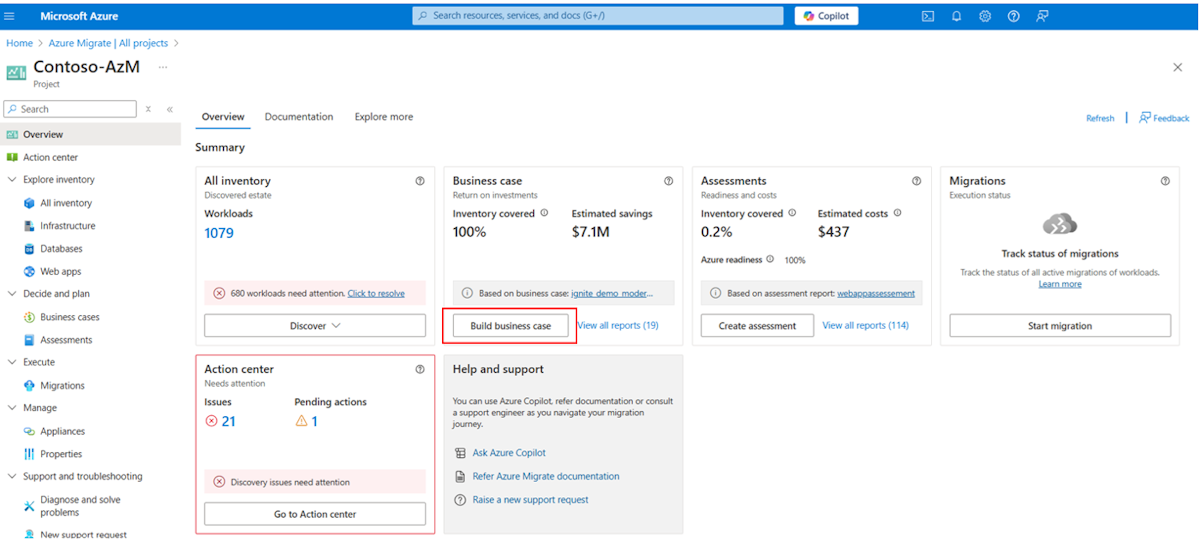
Azure Migrate project overview with business case and assessment cards Shown capabilities depend on licensing and configuration.
Different businesses. Different ways of working. A shared need for technology that supports real operations.









Azure Migrate can support discovery, assessment and selected migration scenarios. A complete migration also needs application ownership, network preparation, testing and an operating model. We coordinate these parts instead of treating data transfer as the entire project.
Inventory servers, databases, applications and owners. Use appropriate discovery tools and stakeholder checks to capture systems that an infrastructure list alone may miss.
Map connections, authentication, scheduled jobs and external providers. A workload that appears isolated can still depend on a file share, hard-coded address or service managed by another team.
Assess target suitability and estimated consumption from available evidence. Include licenses, connectivity, migration effort and ongoing support so the comparison reflects the complete operating picture.
Decide whether to retain, retire, rehost, replatform or redesign each workload. The simplest move is not always the best long-term choice, and modernization should not silently expand the agreed migration scope.
Prepare identity, subscriptions, networking, access, monitoring and recovery before transfer. A successful replication job does not make an unprepared destination ready for business users.
Choose a supported method for the source and target. Rehearse the move, confirm application support and test real user journeys in the target environment.
Plan these transfers according to their own consistency and validation requirements. Coordinate final updates and ownership so application records and supporting files remain aligned.
Set the sequence, outage window, communication plan and launch authority. Define when to stop or recover the transition and what must happen to any new transactions recorded after cutover.
Monitor the first real operating cycles, resolve priority issues and verify recovery. Decommission the old environment only after accepted checks, retention decisions and business approval.
No migration method is suitable for every workload. Source support, application compatibility, data volume, bandwidth and acceptable interruption shape the plan. Downtime, cost and performance expectations are agreed after assessment and tested where possible.
Microsoft reference ↗Connect Azure Migration to the applications your people rely on. Define the business handoff, data ownership and permissions before adding another integration.
Support discovery, assessment and applicable migration workflows. Verify current source support and tool requirements for the environment in scope.
Explore solution ↗
Provide the prepared target environment, including subscriptions, networking, identity and workload hosting.
Explore solution ↗
Offer possible SQL targets with different compatibility and management models. Database transfer and application testing require a specific plan.
Explore solution ↗
Provide appropriate file, object and disk destinations. Preserve required metadata and access while verifying the transferred information.
Explore solution ↗
Establish visibility before production cutover. Compare important health and performance signals with the agreed baseline.

Consider analytical modernization as a separately scoped workstream when migration reveals a wider data need.
Explore solution ↗Our migration plan includes both technical and business handoffs. Every wave has owners, prerequisites, acceptance evidence and a clear decision about when the source environment can be retired.
Read the Microsoft reference ↗Tripearltech provides Azure Migration consulting, implementation and support from Ahmedabad, India, for businesses worldwide. Each engagement starts with your operating needs and a clear division of responsibility.
Review workloads, dependencies and business constraints. Identify unsupported assumptions and produce a prioritized migration scope.
Compare suitable target options and prepare cost assumptions. Record modernization opportunities separately so the migration remains controlled.
Prepare the cloud foundation and access paths. Validate network, identity, monitoring and recovery before moving business workloads.
Rehearse a representative wave and correct the plan from evidence. Execute subsequent waves with documented checks and business involvement.
Coordinate technical steps, communications and acceptance. Reconcile critical data and test the transactions that matter to the business.
Support the agreed early operating period and transfer runbooks. Confirm support responsibilities, retained source information and approved decommissioning.
The value of Azure Migration depends on the process it improves. Explore common industry needs and the implementation decisions that help the solution fit.
Critical systems have narrow maintenance windows and dependencies on local equipment.
Assess latency and connectivity before moving components. Sequence the wave around production constraints and retain explicit recovery decisions.
Orders, warehouse updates and integrations must remain consistent during transition.
Plan final synchronization and business transaction checks across systems. Coordinate with external providers instead of migrating each component independently.
Many small applications have unclear owners and uneven documentation.
Identify business ownership and actual usage before moving them. Retire unused workloads where approved and standardize support for retained applications.
Trading peaks leave little tolerance for disruption.
Choose a suitable business window, rehearse realistic load and define launch criteria. Validate store or channel connectivity alongside the cloud application.
Vendor-supported applications carry licensing and compatibility constraints.
Confirm the permitted target and deployment method with the vendor. Pilot specialist workflows before approving the production wave.
Different teams expect different migration timelines and acceptance processes.
Create waves with named approvers and a shared dependency register. Keep each entity’s readiness visible without losing the overall transition plan.
Explore the Microsoft credential references relevant to this solution and its supporting implementation disciplines.
Migration work draws on Azure administration, architecture and practical cutover experience. A credential is one reference point; the team must also understand the dependencies and business checks in your migration.
Discuss your project team ↗ Exam AZ-104
Azure operations and governance
View official credential ↗ Exam AZ-305
Expert credential · Azure Administrator Associate prerequisite
View official credential ↗Official Microsoft credential references, checked September 2026. These badges identify certification disciplines, not individual employee records. Related and retired credentials are labeled. Ask us about the verified credentials and practical experience of the specialists proposed for your engagement.
Use this guide to organize the discovery, target readiness and business acceptance decisions that should precede an Azure migration.
Bring the right people and questions to your first implementation workshop.
Our Azure Migration delivery approach makes design decisions, acceptance and readiness visible. The people who own the process stay involved from discovery through support.
Build the inventory and validate hidden dependencies.
An agreed migration scope and owners.Design the target and migration waves with acceptance criteria.
A ready destination and approved plan.Test a representative move and business transactions.
A revised runbook supported by evidence.Execute the approved wave and validate the result.
A clear go/no-go decision and acceptance.Support early operations and complete handover before retirement.
Owned operations and approved source closure.Understand the solution, its boundaries and how Tripearltech can support your implementation.
Let’s talk about your business ↗Azure Migrate is Microsoft tooling for supported discovery, assessment and migration scenarios. Tripearltech’s service includes the surrounding planning, target setup, testing, cutover coordination and handover.
Potentially, depending on the source, application and target. We assess supported methods, licensing, connectivity and data-transfer requirements before agreeing the approach.
No. Decide the strategy per workload. A straightforward rehost may be appropriate, while other applications may need changes; keep modernization scope and acceptance explicit.
Some methods reduce interruption, but zero downtime should not be assumed. The source, target, consistency requirements and cutover method determine what is possible.
Combine available discovery evidence with application-owner interviews and tests. Review scheduled jobs, identity, DNS, file access and third-party exchanges, not only visible server connections.
No. Cost depends on the target and how it is operated. Compare the full cost model and review actual consumption after migration rather than promising savings from relocation alone.
Agree checks before the move, including counts, key business totals, representative records and application transactions. A successful transfer status is only one part of acceptance.
The plan should define pause, recovery and rollback conditions, decision authority and data treatment. Rehearse the feasible recovery path before the production transition.
After business acceptance, required retention and recovery decisions, and approval from the responsible owners. Keep decommissioning as a controlled step rather than an automatic consequence of cutover.
Share the workload inventory, major dependencies, locations, business windows and the reason for migrating. We can then scope assessment and identify the evidence needed for planning.