

Natural-language exploration
Ask about Azure services and relevant resources using natural language. Use the response to orient an investigation, then verify the resource scope and assumptions before proceeding.
 MICROSOFT CLOUD & AI
Give your cloud team a more direct way to explore Azure resources, investigate issues and prepare the next action. Tripearltech helps you adopt Azure Copilot within a sound operating model, with the right access, review practices and cloud expertise behind every change.
 View image at full size ↗
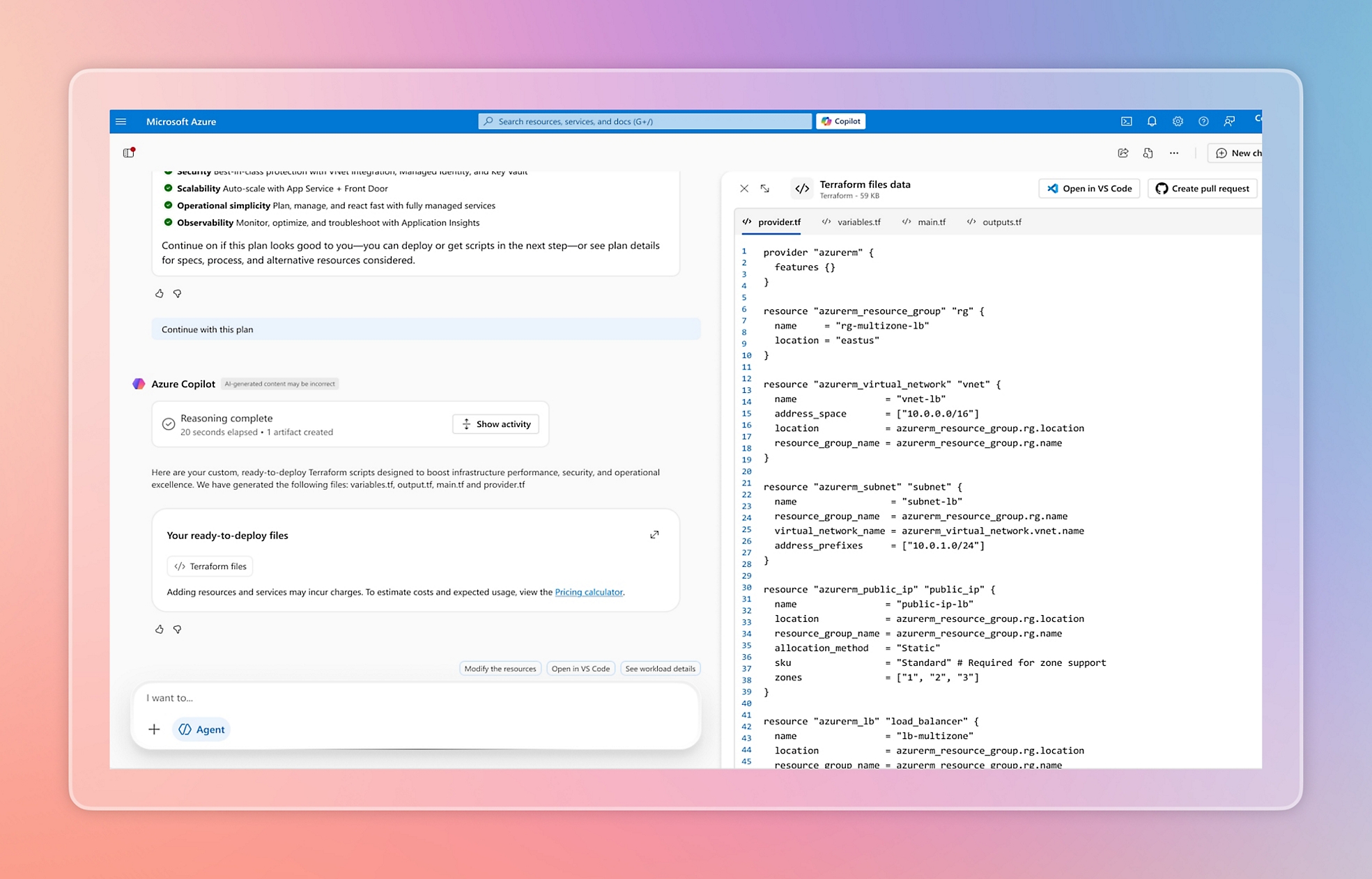
Azure Copilot producing deployable Terraform with an Azure portal chat and code view. Shown capabilities depend on licensing and configuration.
Different businesses. Different ways of working. A shared need for technology that supports real operations.









Azure Copilot supports administrators working with Azure. It is different from Microsoft 365 Copilot and from the platforms used to build your own AI application. We help your team assess its capabilities without losing sight of operational responsibility.
Ask about Azure services and relevant resources using natural language. Use the response to orient an investigation, then verify the resource scope and assumptions before proceeding.
Explore the environment within the access available to the user. A useful operating model still needs consistent ownership, tags and a clear understanding of subscription boundaries.
Prepare supported queries to investigate resources or operational data. Review the query, scope and time period before relying on its result in a business-impacting decision.
Use available assistance to examine a cloud issue and possible next steps. Preserve incident evidence and involve the responsible specialist when the explanation does not match observed behavior.
Explore spending questions and optimization opportunities in supported scenarios. Validate recommendations against service requirements, commitments and expected workload changes.
Assess suggested configuration steps with your team’s standards. A recommendation should be reviewed for access, dependencies and recovery before it becomes a production change.
Azure Copilot operates within user permissions, with confirmation required for actions. Least privilege and change approval remain essential even when the interface makes an action easier to request.
Assess currently available Azure Copilot agents for suitable operational tasks. Check feature status, regional availability and billing rather than assuming every agent follows the same commercial model.
Use reviewed examples to improve internal runbooks and staff understanding. Record the final verified procedure so operational knowledge does not remain only in a chat history.
Current Azure Copilot capabilities are generally included without an additional charge, with usage-based billing for the Observability Agent; future capabilities may differ. Azure resources still incur their own charges. Confirm availability and terms for your cloud environment before rollout.
Microsoft product overview ↗Connect Azure Copilot to the applications your people rely on. Define the business handoff, data ownership and permissions before adding another integration.

The environment Azure Copilot helps users explore and operate. Retain ownership of subscriptions, resources, budgets and production change processes.


The place teams may document incidents and coordinate change. Its workplace Copilot is a different experience with separate entitlements.

Use governed reporting for longer-term operational and financial analysis. Keep the definitions behind management reporting separate from ad hoc investigation.

Consider approved notifications or operational handoffs where a workflow is needed. Do not confuse a workflow’s execution rights with a user’s portal permissions.

Use this when the requirement is your own business agent. It is a separate platform decision from adopting Azure Copilot for cloud administration.

An application data service that may form part of a wider solution. Application permissions and business-record rules remain independently governed.
Azure Monitor, resource management, cost management and identity form important parts of a cloud operating model. We assess the supported Copilot experience alongside these services and define which team owns investigation, approval and execution.
Explore Microsoft’s product details ↗Tripearltech provides Azure Copilot consulting, implementation and support from Ahmedabad, India, for businesses worldwide. Each engagement starts with your operating needs and a clear division of responsibility.
Assess current cloud operations, supported scenarios and administrator needs. Identify a small set of useful tasks and any availability or access constraints.
Review roles, subscription scope and privileged access practices. Confirm that a pilot user has the rights required for the task without unnecessary production authority.
Run guided exercises on real but controlled scenarios. Teach the team to inspect queries, confirm context and distinguish a suggestion from an approved action.
Work through selected investigation scenarios with the relevant cloud specialists. Compare the assisted process with existing evidence and operational procedures.
Update verified procedures and clarify approval points. Define escalation, rollback and audit expectations before expanding use around production resources.
Review operational outcomes, adoption and service changes. Keep support scope explicit and reassess new agent capabilities before introducing them into critical work.
The value of Azure Copilot depends on the process it improves. Explore common industry needs and the implementation decisions that help the solution fit.
Cloud-hosted applications support operations that cannot tolerate unplanned changes.
Pilot investigation tasks before production actions. Map critical dependencies and keep approved maintenance windows and recovery procedures in control.
Variable demand makes performance and cost changes difficult to interpret.
Assess supported resource and cost investigations with application owners. Validate any resizing suggestion against peak demand and business service requirements.
Several client environments create inconsistent operational practices.
Define access boundaries and reusable runbooks per environment. Ensure investigations remain within the authorized subscription and customer scope.
Engineers spend time navigating resources while diagnosing incidents.
Use assistance to form and review queries, then validate the evidence. Capture confirmed findings in the incident record for the next responder.
Integration services connect systems with different owners and support windows.
Map the full dependency chain before acting on one resource. Assign escalation responsibility and verify the effect of a proposed change on connected systems.
New administrators need context without receiving broad production access.
Use role-appropriate exercises and reviewed examples for learning. Keep permissions narrow and require experienced review for changes with operational impact.
Explore the Microsoft credential references relevant to this solution and its supporting implementation disciplines.
Cloud administration and architecture provide the foundation for assessing Azure Copilot suggestions. These references describe Azure disciplines, not a separate Azure Copilot certification.
Discuss your project team ↗ Exam AZ-104
Azure operations and governance
View official credential ↗ Exam AZ-305
Expert credential · Azure Administrator Associate prerequisite
View official credential ↗Official Microsoft credential references, checked September 2026. These badges identify certification disciplines, not individual employee records. Related and retired credentials are labeled. Ask us about the verified credentials and practical experience of the specialists proposed for your engagement.
Use this guide to select Azure Copilot scenarios, establish access boundaries and align assistance with your cloud change and support processes.
Bring the right people and questions to your first implementation workshop.
Our Azure Copilot delivery approach makes design decisions, acceptance and readiness visible. The people who own the process stay involved from discovery through support.
Understand Azure operations, access boundaries and useful scenarios.
A scoped adoption plan and constraints.Select pilot roles and align tasks with change procedures.
Approved access and scenario definitions.Test assistance on controlled investigations and reviewed queries.
Verified findings and documented limitations.Train administrators and update runbooks with accepted procedures.
Team readiness and escalation ownership.Review usefulness, service updates, cost and new agent capabilities.
A controlled path for continued adoption.Understand the solution, its boundaries and how Tripearltech can support your implementation.
Let’s talk about your business ↗It is an AI-assisted experience for working with Microsoft Azure, including exploring resources, preparing queries and investigating operational questions. It uses Azure context within the permissions available to the user.
No. Microsoft 365 Copilot focuses on workplace information and productivity experiences. Azure Copilot focuses on Azure administration and cloud operations.
No. Administrators remain responsible for understanding dependencies, validating recommendations and operating the environment. Copilot can assist the work but does not remove the need for cloud expertise.
It can support actions that the user is authorized to perform, with confirmation required. Keep permissions limited and apply your normal approval and change-management process.
Microsoft currently includes most available capabilities without an extra charge, while the Observability Agent uses usage-based billing. Azure services themselves remain chargeable, and future features may have different terms.
No. Microsoft’s current documentation excludes national clouds such as Azure Government and Azure operated by 21Vianet. Check the current availability and tenant controls for your environment.
It can assist cost investigation in supported scenarios. Any savings depend on the environment and the changes you approve; recommendations must be checked against performance, resilience and business requirements.
Review the query’s scope, filters and time range, and compare the result with known evidence. A query that runs successfully may still answer a different question from the one intended.
Choose a few controlled resource or troubleshooting scenarios and representative administrators. Establish the expected evidence, review steps and escalation route before extending use to more critical tasks.
We can assess suitability, prepare access, run operational workshops, align runbooks and support adoption. The engagement is scoped around your Azure environment and the responsibilities of your internal team.
Azure Copilot overview and pricing ↗ · Azure Copilot capabilities ↗